

Fostering Creative Health
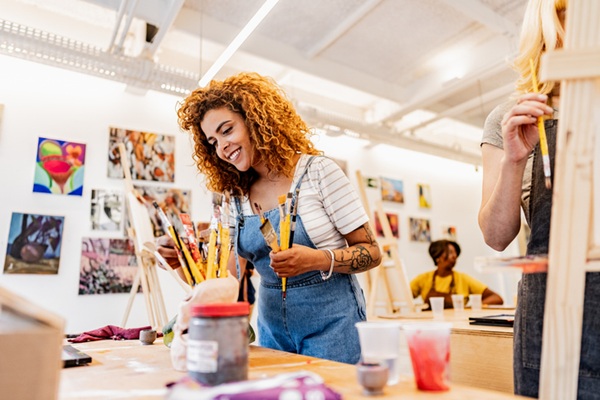
When burnout strikes, you might turn to exercise, meditation, or even a change in diet to heal your exhaustion. But what if you’ve tried everything and are still experiencing a complete lack of presence in your own life? You may be missing an often-overlooked pillar of well-being: creativity.
In a special Annual Wellness Summit preview webcast, “ Feel More Alive: Creative Health as the Missing Pillar of Well-Being,” co-founder and chief science officer of daydreamers Katina Bajaj, M.A., presents creativity as an overlooked component of well-being as well as a powerful tool for healing.
Creativity Is a Spectrum
Through her work, Bajaj discovered that not only is creativity useful in healing burnout, but it is also a distinct area of our well-being, alongside physical and mental health. It has an impact on our capacity for vitality, our ability to move through challenges, and our ability to make meaning—all essential elements for human flourishing.
So, what exactly is creativity? How can we ensure our creative practice is contributing to our well-being? In her discussion, Bajaj outlines the three main aspects of the creative spectrum.
- Creative Expression: This is what we typically think of when we hear the word “creative.” It is a physical, challenging form that connects our minds and bodies to bring something tangible into the world.
- Creative Thinking: The capacity to learn new things and to be cognitively sovereign. This is where we question the status quo, think flexibly, and make space for imagination.
- Capacity for Beauty: The ability to experience awe and wonder in daily life—This is the entry point for inspiration.
The Play Deprivation Crisis
Creativity is an innate human trait that only expands and improves as we age and gain life experience. However, many individuals find themselves “growing out” of creative practices as they age. This problem is worsened by our culture of work, which tends to punish creativity rather than reward it. This phenomenon has been dubbed the “play deprivation crisis.” We are not encouraged to take the time and space to work on projects or ideas that are nonlinear, have no clear goal, and may result in mistakes as a side effect of trying something new. In this way, we have been trained to lead an optimized life rather than a creatively fulfilling one.
Getting Serious
While creativity is meant to be fun, we need to take it seriously, intentionally encouraging creative health and prioritizing it for our collective well-being. A great way to get started is by seeking out creativity-focused spaces in your local community, such as art studios, maker spaces, libraries, writing workshops, performance venues, dance classes, and parks. Creativity is amplified when shared. Just like with parallel play, there are benefits to being in proximity to others when you are being creative!
Ultimately, creative health is part of an individual’s well-being practice. It is important to center the self and consistently make time for creativity. Focus on being creative in a way that is meaningful to you, and endeavor to be less concerned about the output—You will gain more through the process than by striving for perfection.
Resources
Attend Katina Bajaj’s keynote session at the 2026 Annual Wellness Summit to learn more.
The Wellness Alliance in partnership with the International Foundation of Employee Benefit Plans present the 2026 Annual Wellness Summit July 28-30 in Nashville, Tennessee.
Become a member to view webinar recordings. Register for upcoming live events here: https://www.wellnessalliance.org/education-and-events/education-catalog.
About the Contributor
Categories
- Belonging (7)
- Benchmarks (14)
- Benefits (11)
- Cancer (5)
- Culture (44)
- Emotional Wellness (31)
- Healthy Workplaces (36)
- Intellectual Wellness (15)
- Legal and Compliance (10)
- Mental Health (26)
- Occupational Wellness (30)
- Physical Wellness (29)
- Social Wellness (16)
- Spiritual Wellness (5)
- Truth vs. Trend (4)
- Wellness Alliance Events (17)
- Wellness Initiatives (39)
- Workplace Wellness (36)