

Avoiding the “All-or-Nothing” Resolution Trap by Using the Habit Loop


The new year often brings a renewed sense of energy and motivation, especially when it comes to health and wellness goals. Many approach the new year with high motivation and big resolutions, only to quickly feel overwhelmed. In fact, research suggests that around 80% of people abandon their resolutions within the month. January is National Staying Healthy Month, a reminder to prioritize sustainable habits that can support a healthy, balanced lifestyle and prevent the “all-or-nothing” mentality. While the new year is a traditional time to set resolutions and recommit to healthy habits, National Staying Healthy Month reminds us that you don’t have to wait for January to make a positive change.
Why Do New Year’s Resolutions Fail?
The “new year, new me” mantra is exciting in theory, but it rarely works when people try to overhaul everything at once. This often leads to an all-or-nothing mentality and unrealistic expectations that can quickly result in burnout or feelings of failure. Resolutions can also be challenging to maintain when the motivation behind them is rooted in external pressure rather than what truly matters. Without a clear structure or direction, even the best intentions can fade. One of the most effective ways to create lasting change is to focus on sustainable habits.
What Are Habits?
Habits are learned behaviors that shape daily life and overall well-being. While it’s often said that it takes 21 days to form a habit, in fact, research suggests that it actually takes 66 days. Understanding how habits form can help us create positive routines and break unhelpful ones. At the core of every habit is a cycle, but not all habits develop the same way. Some habits form actively through repetition (active habits), while others develop passively through exposure and environment (passive habits).
What Is the Habit Loop?
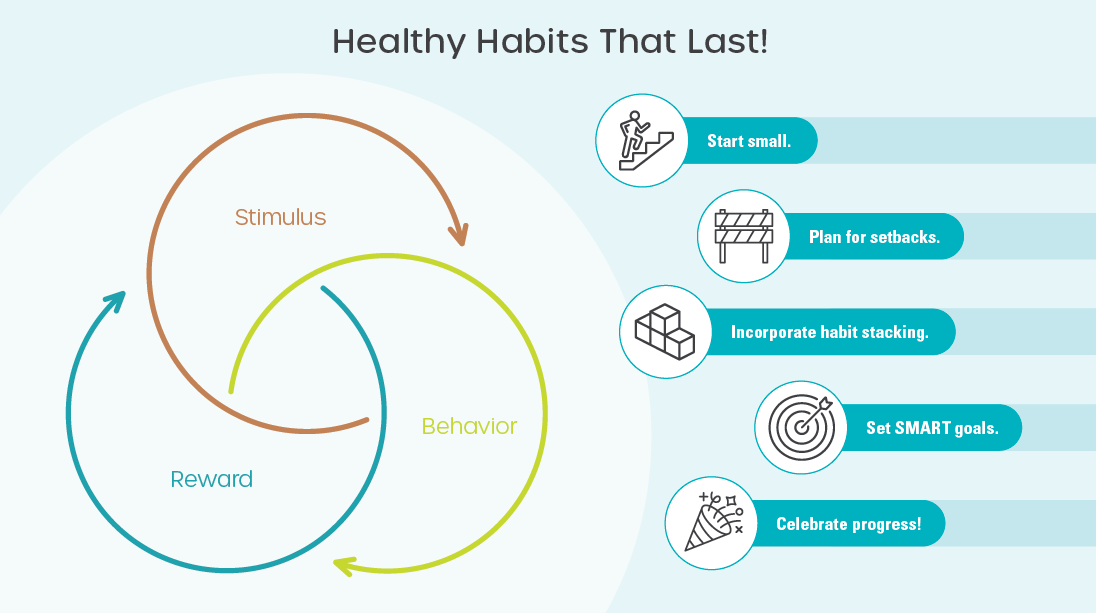
Habits don’t form randomly. They follow a predictable cycle known as the habit loop. While there are several ways to describe it, the loop discussed here includes three key components:
- Stimulus: The trigger that cues the behavior
- Behavior: The action or routine itself
- Reward: The benefit or satisfaction gained from completing the behavior.
How Does the Habit Loop Work?
Here's how the habit loop can be applied to the development of a simple habit, such as teeth brushing.
| Learning to Brush Your Teeth | Brushing Your Teeth Habitually | |
| Stimulus | Parent or guardian prompting you to brush morning and night | Morning, night, or the desire for fresh breath |
| Behavior | Brushing your teeth with support | Brushing your teeth independently |
| Reward | Earning a sticker | A clean mouth and fresh breath |
Over time, the stimulus has slightly changed, but it still exists; the behavior remains the same, and the reward has become more intrinsic (personally motivating) than extrinsic (externally motivating).
The habit loop can be used not only to establish new, healthy habits but also to break old habits that may not be supporting the health and wellness goals you aim to achieve or maintain. To break negative habits, consider these strategies:
- Identify unhelpful routines: Notice the habits that may be holding you back from your goals. For example, staying up late on your phone might make it hard to get out of bed in the morning and leave you feeling low on energy during the day.
- Recognize triggers: Become aware of cues that prompt those unhelpful habits and find ways to reduce your exposure. In this case, charging your phone next to your bed can make late-night screen time more tempting.
- Find positive alternatives: Swap old behaviors for healthier, more supportive routines, rather than just removing them altogether. For example, try reading a book instead of watching videos on your phone before bed.
Tips for Employers to Consider
Committing to behavior change isn’t always easy. Many people start with big goals and strong motivation, only to lose momentum and burn out before they reach their desired outcome. To help employees avoid this pattern, consider integrating the following strategies into a workplace wellness initiative to help employees support sustainable, healthy habits.
- Start small: Encourage employees to be realistic about what’s achievable so they can build confidence as they progress toward their goals.
- Plan for setbacks: Remind employees that setbacks are normal. Being flexible and having a backup plan is key to staying on track!
- Incorporate habit stacking: Suggest adding a new habit onto an existing one to create consistency. For example, if employees want to increase their daily step counts, they could take an extra lap around the building each time they use the restroom or fill up their water bottle to help make movement a regular part of their routine.
- Set goals and make them SMART: Encourage employees to set goals that provide them with a clear direction.
- Specific
- Measurable
- Achievable
- Relevant
- Time-Bound
- Celebrate your progress: Big or small, remind employees to celebrate their success along the way to stay motivated!
Sustainable behavior change isn’t about perfection, and it doesn’t happen all at once. Real change comes when healthy habits become a natural part of your everyday life.
Resources
About the Contributor
Categories
- Belonging (7)
- Benchmarks (14)
- Benefits (11)
- Cancer (5)
- Culture (44)
- Emotional Wellness (31)
- Healthy Workplaces (36)
- Intellectual Wellness (15)
- Legal and Compliance (10)
- Mental Health (26)
- Occupational Wellness (30)
- Physical Wellness (29)
- Social Wellness (16)
- Spiritual Wellness (5)
- Truth vs. Trend (4)
- Wellness Alliance Events (17)
- Wellness Initiatives (39)
- Workplace Wellness (36)